Barbell Plate Calculator
Enter your target weight and see exactly which plates to load on each side
Free · No signup · Works in kg and lbs
Add this calculator to your website
Copy a free iframe widget for your gym site, coaching page, or training blog.
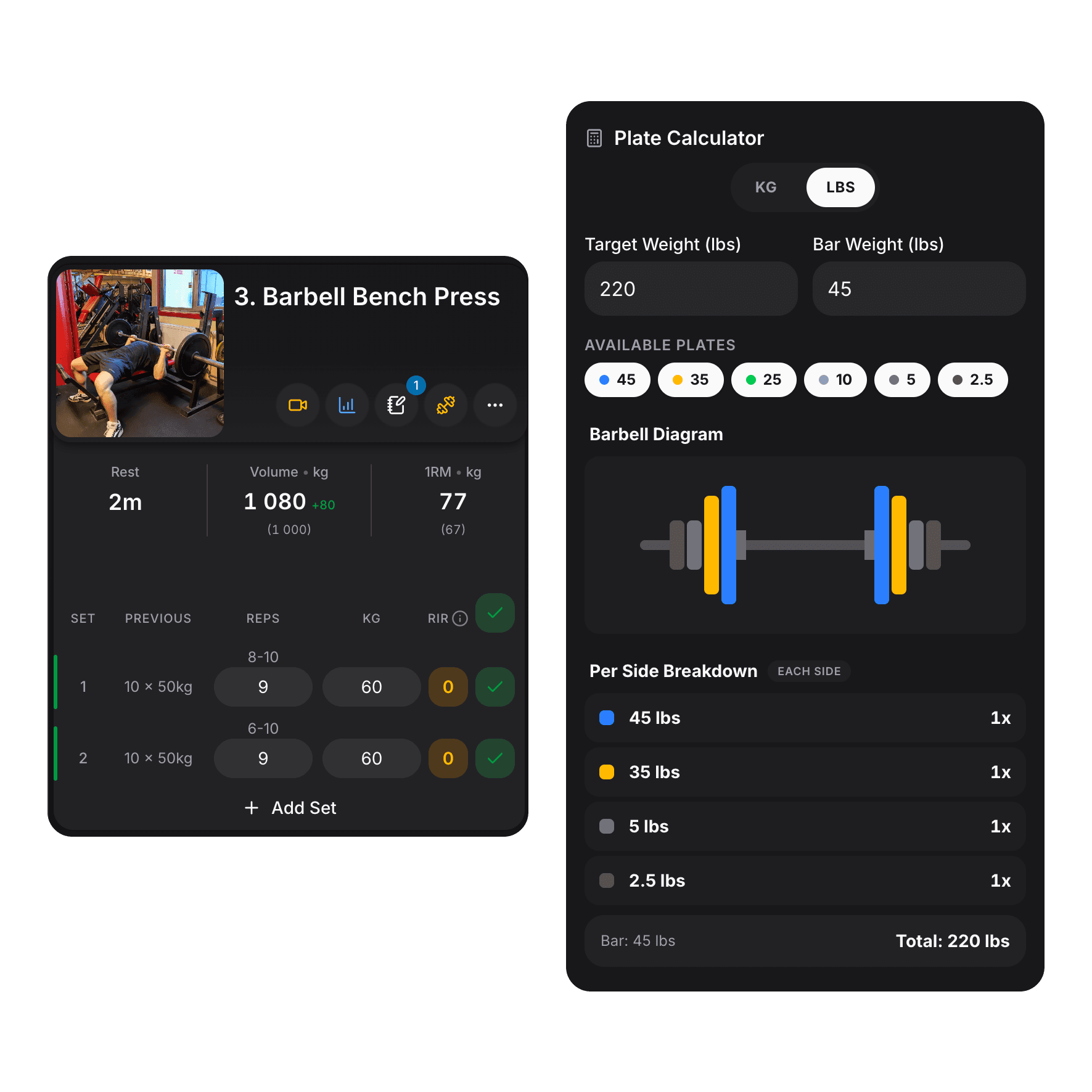
Skip the mental math. Hypro loads the plates for you.
Log a set in Hypro and the plate calculator is right there. Tap the weight, see the plates. No switching apps between sets.
Complete Plate Loading Chart
In gym slang, "plates" means 45 lb (20 kg) plates: "two plates" is two per side. Tap any row to load that weight into the calculator above.
Pounds (45 lb Olympic bar)
| Total | Metric | Plates on each side |
|---|---|---|
| 95 lbs | 43 kg | 1 × 25 |
| 115 lbs | 52 kg | 1 × 25, 1 × 10 |
| 135 lbs | 61 kg | 1 × 45 (one plate) |
| 155 lbs | 70 kg | 1 × 45, 1 × 10 |
| 185 lbs | 84 kg | 1 × 45, 1 × 25 |
| 225 lbs | 102 kg | 2 × 45 (two plates) |
| 245 lbs | 111 kg | 2 × 45, 1 × 10 |
| 265 lbs | 120 kg | 2 × 45, 2 × 10 |
| 275 lbs | 125 kg | 2 × 45, 1 × 25 |
| 300 lbs | 136 kg | 2 × 45, 1 × 25, 1 × 10, 1 × 2.5 |
| 315 lbs | 143 kg | 3 × 45 (three plates) |
| 365 lbs | 166 kg | 3 × 45, 1 × 25 |
| 405 lbs | 184 kg | 4 × 45 (four plates) |
| 495 lbs | 225 kg | 5 × 45 (five plates) |
| 585 lbs | 265 kg | 6 × 45 (six plates) |
| 600 lbs | 272 kg | 6 × 45, 1 × 5, 1 × 2.5 |
Kilograms (20 kg Olympic bar)
| Total | Imperial | Plates on each side |
|---|---|---|
| 60 kg | 132 lbs | 1 × 20 |
| 80 kg | 176 lbs | 1 × 20, 1 × 10 |
| 100 kg | 220 lbs | 2 × 20 (two plates) |
| 120 kg | 265 lbs | 2 × 20, 1 × 10 |
| 140 kg | 309 lbs | 3 × 20 (three plates) |
| 160 kg | 353 lbs | 3 × 20, 1 × 10 |
| 180 kg | 397 lbs | 4 × 20 (four plates) |
| 200 kg | 441 lbs | 4 × 20, 1 × 10 |
| 220 kg | 485 lbs | 5 × 20 (five plates) |
Popular weights
Standard Olympic Plate Sizes
| Metric (kg) | Imperial (lbs) | IWF colour | Type |
|---|---|---|---|
| 25 kg | 55 lbs | Red | Bumper plate |
| 20 kg | 45 lbs | Blue | Bumper plate |
| 15 kg | 35 lbs | Yellow | Bumper plate |
| 10 kg | 25 lbs | Green | Bumper plate |
| 5 kg | 10 lbs | White | Change plate |
| 2.5 kg | 5 lbs | — | Change plate |
| 1.25 kg | 2.5 lbs | — | Change plate |
Common Barbell Types and Weights
- Men's Olympic Bar — 20 kg (44 lbs), 2.2 m long, 28 mm shaft diameter. Standard in most gyms.
- Women's Olympic Bar — 15 kg (33 lbs), 2.01 m long, 25 mm shaft diameter. Used in women's Olympic weightlifting.
- Training Bar — 10 kg (22 lbs). Shorter and lighter, for beginners or warm-ups.
- EZ Curl Bar — 6-10 kg (13-22 lbs). Angled grip for bicep curls and tricep extensions.
- Trap / Hex Bar — 20-27 kg (44-60 lbs). Hexagonal shape for deadlifts and shrugs.
Tips for Loading Plates Safely
- Always use barbell clips (collars) to prevent plates from sliding off during the lift.
- Load plates evenly on both sides. Never load one side significantly heavier than the other — an unbalanced bar can tip and cause serious injury.
- Place the heaviest plates closest to the collar and lighter plates on the outside for stability.
- When stripping weight between sets, remove plates from both sides alternately to keep the bar balanced.
Frequently Asked Questions
References & Standards
Bar weights, plate weights, and the colour coding used in this calculator follow the official equipment specifications published by the sport's governing bodies and major manufacturers.
- International Weightlifting Federation (IWF) Technical and Competition Rules & Regulations: defines the 20 kg men's and 15 kg women's Olympic bars and the colour coding for competition plates (25 kg red, 20 kg blue, 15 kg yellow, 10 kg green).
- International Powerlifting Federation (IPF) Technical Rules Book: specifies approved barbells and calibrated plates for squat, bench press, and deadlift competition.
- Rogue Fitness Olympic bar and plate specifications: a widely used reference for commercial and home gym equipment dimensions and weights.
Reviewed by Dawid Kowalczyk, Personal Trainer and IFBB Pro competitor. Always confirm your own gym's bar weight, since some commercial bars vary slightly from the standard specification.
Related Tools
- 1RM Calculator — Estimate your one rep max and get percentage-based training loads to know exactly how much to load for each set.
- Wilks Calculator — Compare your powerlifting total across bodyweight classes using the Wilks and DOTS formulas.
- Hypertrophy Calculator — Calculate weekly training volume for every muscle group based on your experience level.
Last updated April 16, 2026 · Reviewed by Dawid Kowalczyk, Personal Trainer & IFBB Competitor