Best Lifting Programs Compared: 5x5, 5/3/1, nSuns, GZCLP, PHUL, PHAT
The best lifting program is not the hardest spreadsheet you can survive. It is the progression model that fits how quickly you can still improve. Compare 5x5, GZCLP, nSuns, PHUL, 5/3/1, and PHAT by training days, recovery cost, and what happens when the easy gains slow down.
 Maciej Glowacki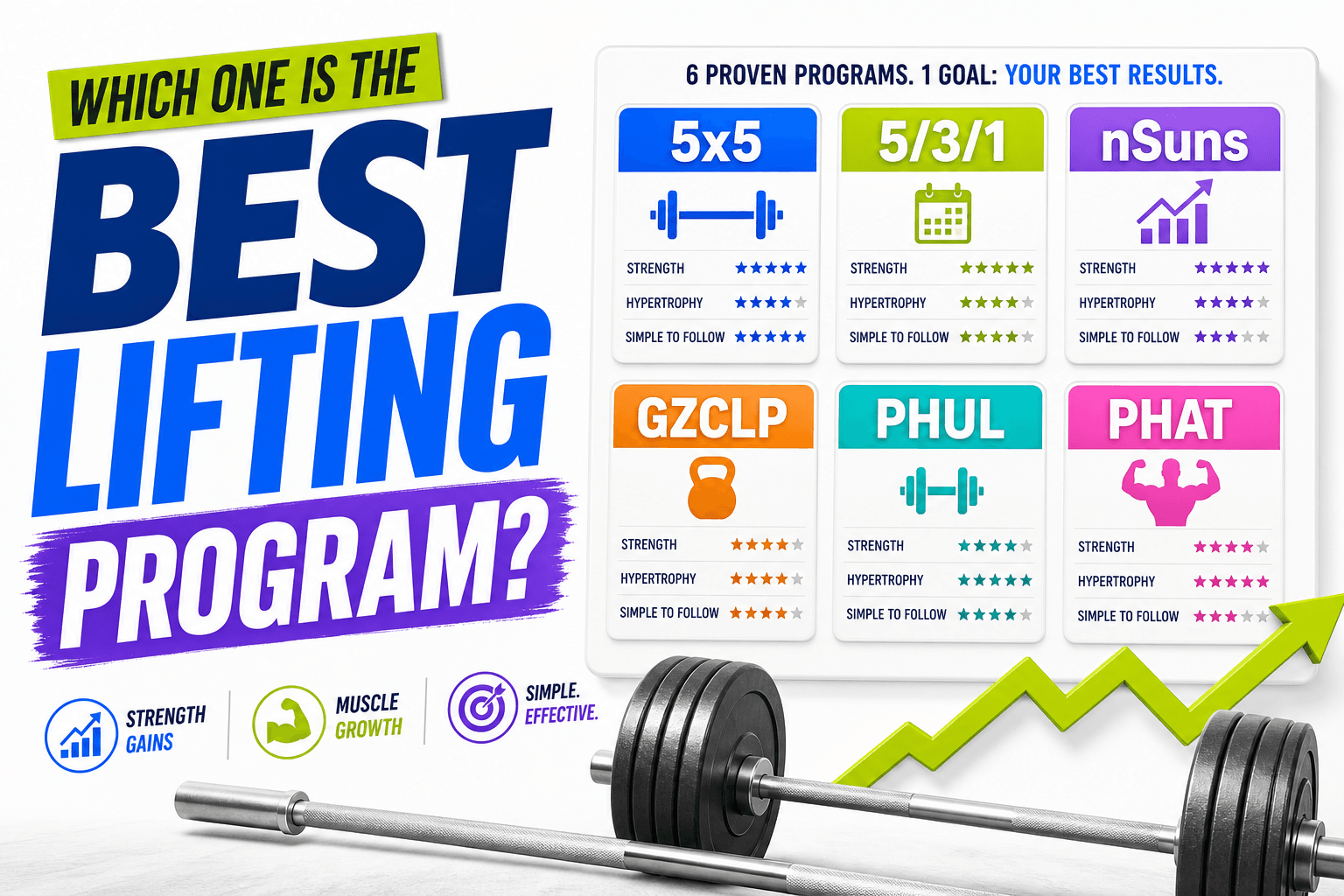
Six programs dominate every "what should I run" thread: 5x5, GZCLP, nSuns, 5/3/1, PHUL, and PHAT. All can organize productive training. They do it with very different amounts of volume, complexity, and patience.
The useful question is not "Which program is most advanced?" It is "How often can I realistically progress?" Newer lifters often suit a simple linear progression such as 5x5 or GZCLP. When session-to-session increases stop being repeatable, weekly progression and more flexible loading become useful. Slower wave-based programs such as 5/3/1 suit lifters who no longer expect a personal record every Friday.
Key takeaways:
- Match progression speed to your actual training response. The labels beginner, intermediate, and advanced are useful shorthand, not a stopwatch.
- For 1RM strength, a 2023 network meta-analysis of 178 studies ranked higher-load, multi-set prescriptions highest on average.
- For muscle size, the same analysis found load mattered far less: hard sets and weekly volume drive hypertrophy on any of these programs.
- PHUL and PHAT make physique work explicit with dedicated hypertrophy days. That may suit lifters who would otherwise forget everything that is not a main lift.
- Every program on this list relies on record-keeping. Progression rules need your previous loads, reps, or top-set performance.
All six programs at a glance
| Program | Days/week | Progression | Best for | Main lift structure |
|---|---|---|---|---|
| 5x5 (StrongLifts) | 3 | Per session, with lift-specific increments | Beginners | 5x5 squat, bench, row, OHP; 1x5 deadlift |
| GZCLP | 3-4 | Per session, auto-adjusting | Beginners | Tiered: 5x3+, 3x10, 3x15+ |
| nSuns | 4-6 | Weekly, AMRAP-based | Late beginner to intermediate | 9-set main lift waves |
| PHUL | 4 | Rep-range progression | Intermediate, size + strength | 2 power + 2 hypertrophy days |
| 5/3/1 | 3-4 | Multi-week waves | Intermediate to advanced | 5s / 3s / 5-3-1 weeks in the classic template |
| PHAT | 5 | Exercise-specific progression | Advanced, physique focus | 2 power + 3 hypertrophy days |
The beginner tier: 5x5 and GZCLP
5x5 (StrongLifts and its variants). Three full-body sessions per week alternate squat/bench/row with squat/overhead press/deadlift, commonly using five sets of five and small load increases. Its strength is clarity: there is little doubt about what to do next. Its weakness is what it leaves out. Five compound lifts provide little direct work for arms and side delts, while frequent 5x5 squatting becomes demanding once the early linear increases stop.
GZCLP fixes the stall problem with structure. Each session has a tier-1 heavy lift (5 sets of 3, last set AMRAP), a tier-2 volume lift (3 sets of 10), and tier-3 isolation (3 sets of 15+). When you stall, the program prescribes the next rep scheme instead of a blind reset: 5x3 becomes 6x2, then 10x1, then a weight reset. It is the better-engineered linear progression, at the cost of being slightly harder to learn.
Verdict: pick GZCLP if you want built-in stall handling and accessory work; pick 5x5 if you want maximum simplicity. Stay with session-to-session progression while it remains realistic, then change the progression model instead of forcing increases that are no longer there.
The intermediate tier: nSuns and PHUL
nSuns adapts 5/3/1-style loading into weekly progression with a large prescribed workload: commonly 9 sets on the main lift, 8 on a secondary lift, then accessories, across 4-6 days. That structure can make sessions long and recovery demanding. This is a description of the workload, not evidence that nSuns produces faster strength gains than lower-volume programs. Use it only when the schedule and volume fit your recovery.
PHUL (Power Hypertrophy Upper Lower) is the balanced pick: four days on an upper/lower structure, two power days (3-5 reps on the big lifts) and two hypertrophy days (8-12 reps, more machines and isolation). Every muscle gets trained twice per week, which distributes weekly work without requiring marathon sessions. A 2019 hypertrophy meta-analysis found frequency itself made little difference when volume matched, while a 2018 strength meta-analysis by Grgic et al. associated higher frequency with greater strength gains largely through added volume.
Verdict: PHUL is a practical default for intermediates who want strength and hypertrophy work in a four-day week. nSuns suits lifters who prefer its weekly progression model and can recover from the prescribed workload. Neither choice comes with a guaranteed timeline or rate of progress.
The advanced tier: 5/3/1 and PHAT
5/3/1 (Jim Wendler) accepts that experienced lifters may need slower progression. Classic versions use a conservative training max and three-week waves: a 5s week, a 3s week, and a 5/3/1 week, often with a final plus set, followed by a small training-max increase. Exact percentages and assistance work vary across editions and templates. Options such as Boring But Big add hypertrophy volume. The method rewards patience; lifters who quietly turn every conservative set into an unscheduled max defeat the point.
PHAT (Layne Norton's Power Hypertrophy Adaptive Training) is the high-volume physique option: five days, two power days and three hypertrophy days with speed work and higher-rep accessories. Its weekly workload can be demanding. Volume research supports a dose-response with diminishing returns, not one magic set target (Schoenfeld et al., 2017). Treat PHAT as a template to scale, not a toughness test.
Verdict: 5/3/1 if strength is the goal and you are comfortable with patient progress. PHAT if size is the priority and you can recover from, and genuinely enjoy, five high-workload days.
What the research says about choosing
Two findings cut through most program debates:
- For strength, load matters. A 2023 network meta-analysis by Currier et al. across 178 studies ranked higher-load, multi-set prescriptions as the most effective for 1RM strength. That favors the heavy top sets in 5/3/1, nSuns, and the power days of PHUL/PHAT.
- For size, volume and effort matter, load matters less across sufficiently challenging sets. The same analysis found similar hypertrophy across load ranges, and a 2026 analysis by Pelland et al. of 67 studies found a positive weekly-volume dose-response with diminishing returns. That is why the hypertrophy days in PHUL and PHAT, and the tier-2/3 work in GZCLP, do the physique building.
In other words: each program can organize productive training, but none removes the need to adjust. The useful differences are progression speed, volume dose, and recovery cost. If you mainly want muscle and the barbell numbers are secondary, a simpler split built around weekly volume targets may get you there with less complexity.
The part every program leaves out: tracking
All six programs are progression rule sets. 5x5 needs last session's weights. nSuns computes next week from this week's AMRAP. 5/3/1 needs your training max and cycle position. PHUL and PHAT need double progression history on 20+ exercises. The moment you guess instead of track, the program stops being the program.
Spreadsheets solve this until a set at the gym does not match a cell. Hypro logs the actual session and uses that history for Smart Progression. Free accounts receive one suggestion per exercise; Premium provides suggestions for every working set.
Every program here relies on progression rules. Browse Hypro's plans, try one demo day for free, or test complete plans during the 7-day Premium trial.
Browse training plans
Maciej Glowacki
Founder and CEO of Hypro. Built the platform from the ground up with years of hands-on lifting experience.