Dumbbell Workout Plan: Build Muscle With Nothing But Dumbbells
A pair of dumbbells can take you much further than the corner of a hotel gym suggests. This dumbbell workout plan covers 3-day full-body and 4-day upper/lower routines, then solves the real limitation: how to progress when the next pair is a large jump.
 Maciej Glowacki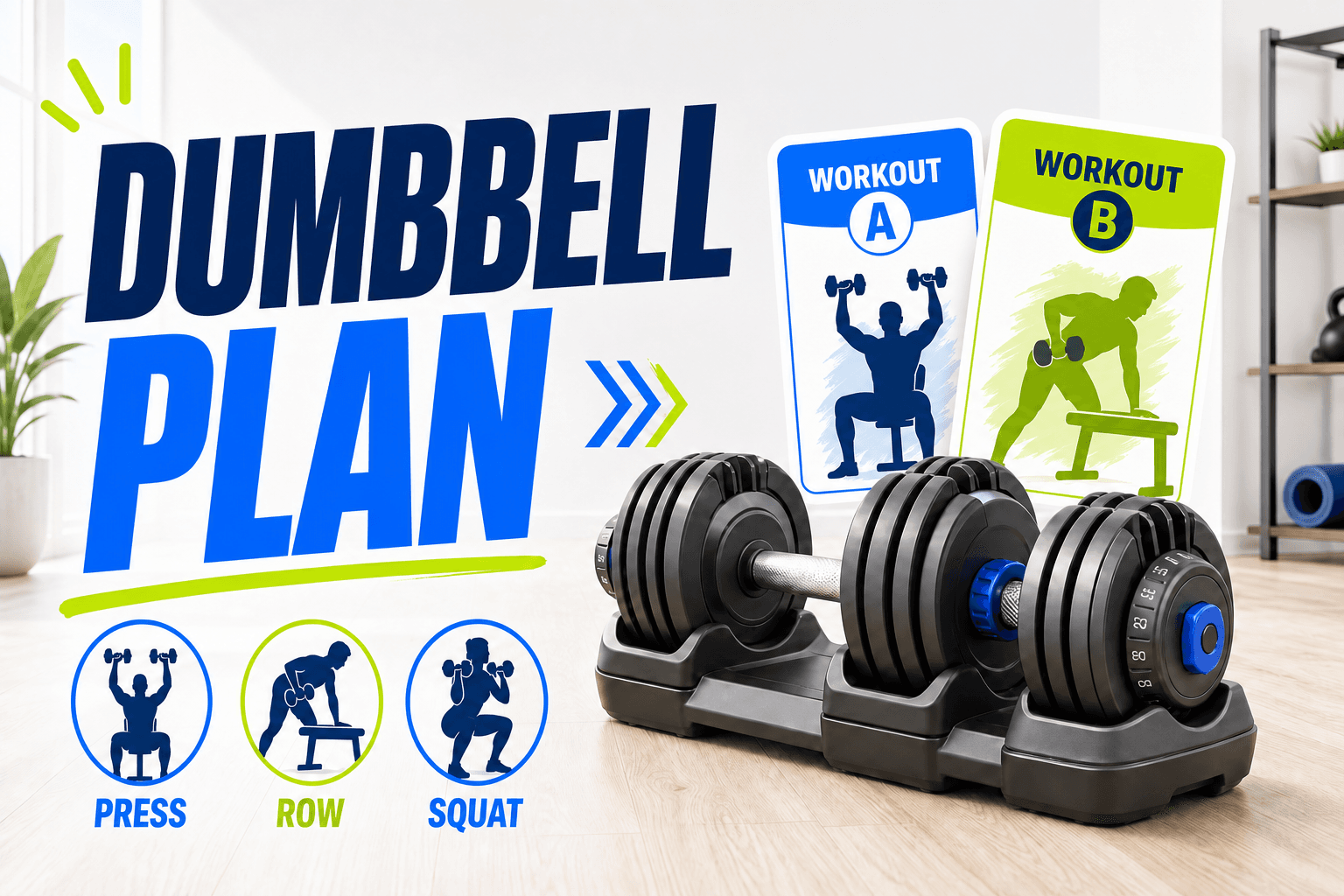
You can build muscle with nothing but dumbbells. They let you train the major movement patterns through long ranges of motion, and they can stay challenging from your first goblet squat to heavy presses and rows. A 2023 network meta-analysis by Currier et al. compared resistance-training prescriptions across 178 studies and found that many combinations of load, sets, and frequency produced hypertrophy. The paper did not test dumbbells against every other implement, but it supports the broader point: there is more than one productive way to load a muscle.
What changes with dumbbells is how you program around the available load and stability demands. Weight jumps are often fixed, and some lower-body lifts become difficult to load heavily. This plan is built around those constraints: a 3-day full-body routine, a 4-day upper/lower version, and a progression method for fixed jumps.
Key takeaways:
- Dumbbells can provide the resistance, exercise selection, and progression needed to build muscle. Their limits are load range and fixed jumps, not a lack of muscle-building magic.
- In the 3-day rotation, chest, back, and quads average about 9 direct sets per week; shoulders and hamstrings about 7-8; and each arm muscle about 3 direct sets plus indirect work.
- Progress by reps first: work from 8 to 15 reps before adding weight, because dumbbell jumps are proportionally large.
- Keep most working sets challenging while leaving enough RIR to maintain control. Absolute failure is not required.
- Adjustable dumbbells provide the longest runway. Buy enough load for rows and lower-body work, not only curls and presses.
The 3-day full-body dumbbell plan
Train Monday, Wednesday, Friday, alternating the two templates (A/B/A one week, B/A/B the next). The structure mirrors our full body workout plan, converted to dumbbell-only exercises:
Workout A
| Exercise | Sets x Reps |
|---|---|
| Goblet squats | 3 x 8-15 |
| Flat dumbbell press | 3 x 8-12 |
| Single-arm dumbbell row | 3 x 8-12 per arm |
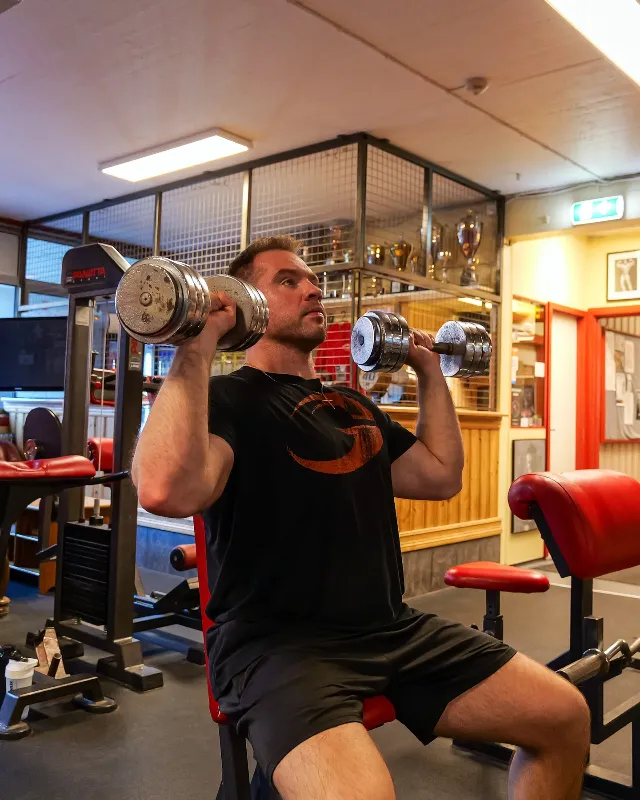
| Seated dumbbell shoulder press | 2 x 8-12 |
| Dumbbell Romanian deadlift | 3 x 8-12 |
| Dumbbell curls | 2 x 10-15 |
Workout B
| Exercise | Sets x Reps |
|---|---|
| Bulgarian split squats | 3 x 8-12 per leg |
| Incline dumbbell press | 3 x 8-12 |
| Chest-supported dumbbell row | 3 x 10-12 |
| Lateral raises | 3 x 12-20 |
| Dumbbell leg curls or hip thrusts | 2 x 10-15 |
| Overhead triceps extension | 2 x 10-15 |
Across the A/B rotation, chest, back, and quads average about 9 direct sets per week. Shoulders and hamstrings average about 7-8, while biceps and triceps each average about 3 direct sets plus indirect work from rows and presses. These are table-specific counts, not universal targets. Use the weekly-volume guide to count overlap and adjust from progress and recovery.
The 4-day upper/lower dumbbell plan
When you can train 4 days and want more volume, split the body in half. Every muscle stays at twice-weekly frequency, which helps spread your weekly sets across shorter sessions. A 2019 meta-analysis found no meaningful hypertrophy advantage to higher frequency when weekly volume was matched:
Upper (Monday and Thursday)
| Exercise | Sets x Reps |
|---|---|
| Flat dumbbell press | 4 x 8-12 |
| Single-arm dumbbell row | 4 x 8-12 per arm |
| Seated dumbbell shoulder press | 3 x 8-12 |
| Lateral raises | 3 x 12-20 |
| Dumbbell curls | 2 x 10-15 |
| Overhead triceps extension | 2 x 10-15 |
Lower (Tuesday and Friday)
| Exercise | Sets x Reps |
|---|---|
| Goblet or dumbbell squats | 4 x 8-15 |
| Dumbbell Romanian deadlift | 4 x 8-12 |
| Bulgarian split squats | 3 x 8-12 per leg |
| Single-leg calf raises | 3 x 12-20 |
Vary the second weekly session slightly (incline press instead of flat, chest-supported row instead of single-arm) so the week trains movements from two angles. The scheduling logic is identical to the barbell upper/lower split.
How to progress with fixed weight jumps
The biggest dumbbell constraint is jump size. Moving from 12 kg to 14 kg dumbbells is a 17% load increase; a barbell moves in 2.5% steps. The fix is wide-range double progression:
- Pick a rep range of 8-15 (wider than the barbell standard).
- Keep the weight fixed and add reps session to session: 3 x 8, then 3 x 10, up to 3 x 15.
- Only then take the jump to the next dumbbell, dropping back to 3 x 8.
Two details make this work. First, effort: the set must be challenging enough to create a reason to adapt, but you do not need absolute failure. A 2023 meta-analysis by Refalo et al. found no hypertrophy advantage to momentary muscular failure over non-failure training. Use RIR to keep effort honest without turning technique into a casualty. Second, single-side exercises such as split squats and one-arm rows make the same dumbbell challenging for one limb at a time.
Track it rather than guessing: the progressive overload calculator tells you when to add reps or take the jump on each lift.
What dumbbells do you actually need?
For many beginners, adjustable dumbbells covering roughly 2-24 kg provide a useful starting range, but lower-body strength and product designs vary widely. Use this only as a shopping guide:
| Exercise class | Typical need |
|---|---|
| Lateral raises, curls | 4-14 kg |
| Presses, rows | 10-30 kg |
| Squats, RDLs, split squats | 16-40 kg |
Lower-body lifts often outgrow a light dumbbell set first. Single-leg variants, pauses, and longer ranges of motion extend the runway. When the available pair no longer makes the target movement challenging in the planned rep range, you need a heavier implement or a different exercise.
Browse Hypro's dumbbell-only plans, try one demo day for free, or test complete plans during the 7-day Premium trial.
Browse training plans
Maciej Glowacki
Founder and CEO of Hypro. Built the platform from the ground up with years of hands-on lifting experience.