Lose Fat, Not Muscle: How Diet and Training Actually Work Together
You can lose weight the right way or the wrong way. The difference shows up in the mirror. Lose weight wrong and the scale drops while you get softer and look "skinny-fat." Lose weight right and you shrink in all the right places and keep your shape. A 2026 study of 304 adults found that people who lifted weights during a calorie deficit were the only group to gain lean mass while losing the most fat. Everyone else lost muscle along with fat. Here is how to be in the right group.
 Maciej Glowacki
Losing weight comes down to one thing: eating fewer calories than you burn. That gap is called a calorie deficit. But how you create that deficit decides what you actually lose: fat, muscle, or both.
Lose weight with only a strict diet and no training and you will likely shed muscle along with fat. That is the "skinny-fat" outcome. You get lighter but softer and weaker. Researchers call this low-quality weight loss.
Lose weight with a moderate deficit, resistance training, and enough protein, and you can lose mostly fat while keeping, or even adding, lean mass. A 2026 study by Lahav, Yavetz, and Gepner at Tel Aviv University tracked 304 adults on a ~500 kcal daily deficit for about five months on average, measuring body composition with DXA scans. The resistance training group was the only group to gain lean mass (+0.8 kg in men, +0.9 kg in women) while also producing the greatest reduction in fat mass. The aerobic exercise group and the no-exercise group both lost lean mass.
The takeaway: lifting is not optional if you want to lose fat, not muscle.
Key takeaways: A calorie deficit drives fat loss. Food controls the deficit, not the app. Safe pace: 0.5-1% of bodyweight per week, roughly 300-500 kcal below maintenance. Resistance training is the top lever for keeping muscle while cutting. Protein: 1.6-2.2 g per kg of bodyweight per day. Walking and moderate cardio add extra burn. Consistency beats intensity. Faster is not better.
How long will it take to reach your goal?
Estimates based on safe weight loss rates. Diet controls the pace, training protects your muscle.
Commitment level
Around 0.5-0.75% per week, a ~300-500 kcal deficit. Recommended for most people.
Estimated time to lose 10.0 kg
16–24 weeks
Losing about 0.4–0.6 kg per week
Estimated goal date: 1 Dec 2026
Estimates only. Actual results depend on calorie accuracy, adherence, and individual metabolism. Range reflects 0.5-0.75% bodyweight loss per week.
How does losing weight actually work?
Your body burns a certain number of calories every day to stay alive and move around. That number is your total daily energy expenditure (TDEE). When you eat less than your TDEE, your body draws on stored energy, mostly fat, to make up the gap. That gap is the calorie deficit.
The idea that you can out-train a bad diet is mostly false. Exercise adds roughly 10-20% on top of your baseline calorie burn on a good day. Food controls 80-90% of the equation. If you eat 600 calories more than you burn at the gym, the gym session did not help. See our breakdown of what actually raises your calorie burn for a full look at TDEE.
The calorie deficit should come mostly from eating less, not from exercising more. Training plays a different, more important role: it signals your body to keep the muscle you have while fat is being burned.
How fast is it safe to lose weight?
The speed of weight loss determines what you lose. Faster loss means more muscle loss. Slow, steady loss means mostly fat.
A safe and sustainable rate is 0.5-1% of your bodyweight per week. For an 80 kg person, that is 0.4-0.8 kg per week. This roughly corresponds to a daily calorie deficit of 300-500 kcal. Bigger deficits lead to more muscle loss alongside fat, and they trigger stronger hunger signals and metabolic slowdown.
Crash diets (very low calorie, typically under 1,000-1,200 kcal for most people) accelerate muscle loss because your body cannot get enough protein and energy to protect lean tissue. They also trigger metabolic adaptation faster, meaning your body burns fewer calories at rest. You lose weight fast, then regain it when you return to normal eating.
Who should speak to a doctor first: If you have a history of disordered eating, are pregnant or breastfeeding, have a diagnosed metabolic or hormonal condition, or need to lose a large amount of weight, see a doctor or registered dietitian before starting. This article is for generally healthy adults planning a moderate fat loss phase.
What is the yo-yo effect and how do you avoid it?
The yo-yo effect (sometimes called yo-yo dieting or the jojo effect) is a cycle of losing weight, regaining it, losing again, and regaining again. Each cycle tends to make body composition worse, not better.
Here is why it happens. When you lose weight fast, you lose both fat and muscle. Muscle is metabolically expensive: it burns calories even at rest. Lose muscle and your resting calorie burn drops. When you return to eating normally, your metabolism is lower than before, so you gain fat more easily. Hunger hormones also increase after aggressive dieting, making it harder to resist overeating.
Fothergill et al. tracked 14 participants from "The Biggest Loser" competition for 6 years after the show. The competitors lost an average of 58 kg during the competition and then regained an average of 41 kg. Six years later, their resting metabolic rate was still 704 kcal per day below where it started, despite having regained most of the weight. The aggressive deficit had caused a metabolic adaptation that persisted for years.
How to avoid the yo-yo effect:
- Keep the deficit moderate. Target 300-500 kcal below maintenance, not 800-1,000+.
- Eat enough protein. Aim for 1.6-2.2 g per kg of bodyweight per day. Protein protects muscle during a deficit.
- Keep lifting. Resistance training is the strongest signal to preserve lean mass. Losing muscle is what lowers your metabolism and causes faster regain.
- Plan a maintenance phase. After reaching your goal, spend 4-8 weeks eating at maintenance before deciding what to do next. Do not snap back to old eating patterns overnight.
- Build a repeatable routine, not a temporary diet. Diets have end dates. Habits do not.
The gym results checklist covers the habit side in more depth. The stop searching for the perfect plan article makes the case for consistency over perfection.
Will I lose muscle when I lose weight?
Probably not much, if you lift consistently and eat enough protein. But the risk is real if you do not.
Most people in a moderate calorie deficit who are lifting consistently and eating 1.6+ g/kg of protein will maintain or nearly maintain their lean mass. Some, especially beginners or people returning to training after a long break, can even gain lean mass during a deficit. Researchers call this body recomposition: losing fat and gaining muscle at the same time. It is more common than most people expect, particularly in people new to lifting or carrying more body fat.
For people who are already trained and relatively lean, the realistic goal during a cut is to keep the muscle you have, not to build more. For a realistic look at how long muscle building takes in a calorie surplus, see our muscle growth timeline guide.
What training keeps muscle while you cut?
Resistance training is the key. When you lift weights, you send a signal to your body that your muscles are being used and should be preserved. Without that signal, the body treats muscle as a costly luxury during an energy shortage and breaks it down.
The minimum effective volume for maintaining muscle during a cut is roughly 4-6 hard sets per muscle group per week, based on research on maintenance volume. That is less than what you need to build muscle, but enough to keep what you have. See our weekly sets per muscle group guide for the exact numbers.
Key principles for training during a fat loss phase:
- Keep the same exercises and weight ranges you used when building. Do not switch to lighter weights and higher reps assuming it will "tone" you.
- Do not cut training volume dramatically. A reduction of 20-30% from your building volume is fine.
- Take rest periods seriously. Rest 2-3 minutes between hard sets. When calories are low, recovery is limited. Cutting rest periods hurts intensity.
- Keep protein high. A 2018 meta-analysis of 49 studies by Morton et al. found that protein intakes up to 1.62 g/kg/day maximized lean mass retention in people training with resistance exercise. During a cut, aim for 1.6-2.2 g per kg per day. Protein is more important during a cut than a bulk.
Does cardio help? Walking vs HIIT
Cardio helps, but it plays a supporting role. The deficit comes mainly from eating less. Cardio adds extra calorie burn on top. The safest, most sustainable cardio during a cut is walking.
Walking is underrated for fat loss. 7,000-10,000 steps per day burns an extra 300-500 kcal depending on your size. It is low-impact, does not interfere with lifting recovery, and is easy to do every day. Your total non-exercise activity, including walking, fidgeting, and standing, is called NEAT. It accounts for a surprising share of your daily calorie burn. See our full NEAT and TDEE guide.
Zone 2 cardio (a pace where you can hold a conversation, around 60-70% of max heart rate) burns fat efficiently without much muscle breakdown. Two to three sessions of 30-45 minutes per week is a solid target.
HIIT is optional. It burns calories efficiently in a short time but is taxing on the body. On a calorie deficit, recovery capacity is already limited. If you are lifting 3 days per week and doing HIIT on top, fatigue can accumulate and hurt your lifting quality. Start with walking, add Zone 2 if needed, and add HIIT only if you are recovering well.
Estimate how much your training and walking add to your weekly burn below.
How many calories can your training and walking burn?
A rough estimate of weekly calorie burn from exercise and daily steps. Remember: diet is still what creates the deficit.
Fat loss contribution (on top of diet deficit)
~1.9 – 2.6 kg/month
If your diet is already at maintenance. Add a 300-500 kcal daily deficit on top for total fat loss.
Exercise alone rarely creates a large enough deficit for meaningful fat loss. These numbers show training and walking as a helpful boost, not the main driver. The main driver is eating less than your TDEE.
Estimates based on average calorie expenditure ranges. Actual burn depends on bodyweight, intensity, and fitness level. Lifting: 200-350 kcal/session. Zone 2: 5-8 kcal/min. Walking: ~80-100 kcal per 2,000 steps.
An example plan you can start today
You do not need a complicated program to lose fat while keeping muscle. A simple structure repeated consistently beats an elaborate plan done halfway.
Weekly template for fat loss with muscle retention:
Walking is a daily habit, not a rest-day chore. Aim for 8,000+ steps every day, then layer your training focus on top.
| Day | Training focus | Daily steps |
|---|---|---|
| Monday | Full-body lifting (3-4 sets per muscle) | 8,000+ |
| Tuesday | Rest or light activity, stretch if wanted | 8,000+ |
| Wednesday | Full-body lifting | 8,000+ |
| Thursday | Rest, optional Zone 2 cardio (30 min) | 8,000+ |
| Friday | Full-body lifting | 8,000+ |
| Saturday | Active rest: walk, swim, bike, whatever you enjoy | 8,000+ |
| Sunday | Full rest | 8,000+ |
Protein target: 1.6-2 g per kg of bodyweight per day. For an 80 kg person, that is 128-160 g/day.
Calorie deficit: 300-500 kcal below your TDEE. Use the free TDEE calculator or calorie calculator to find your maintenance number first.
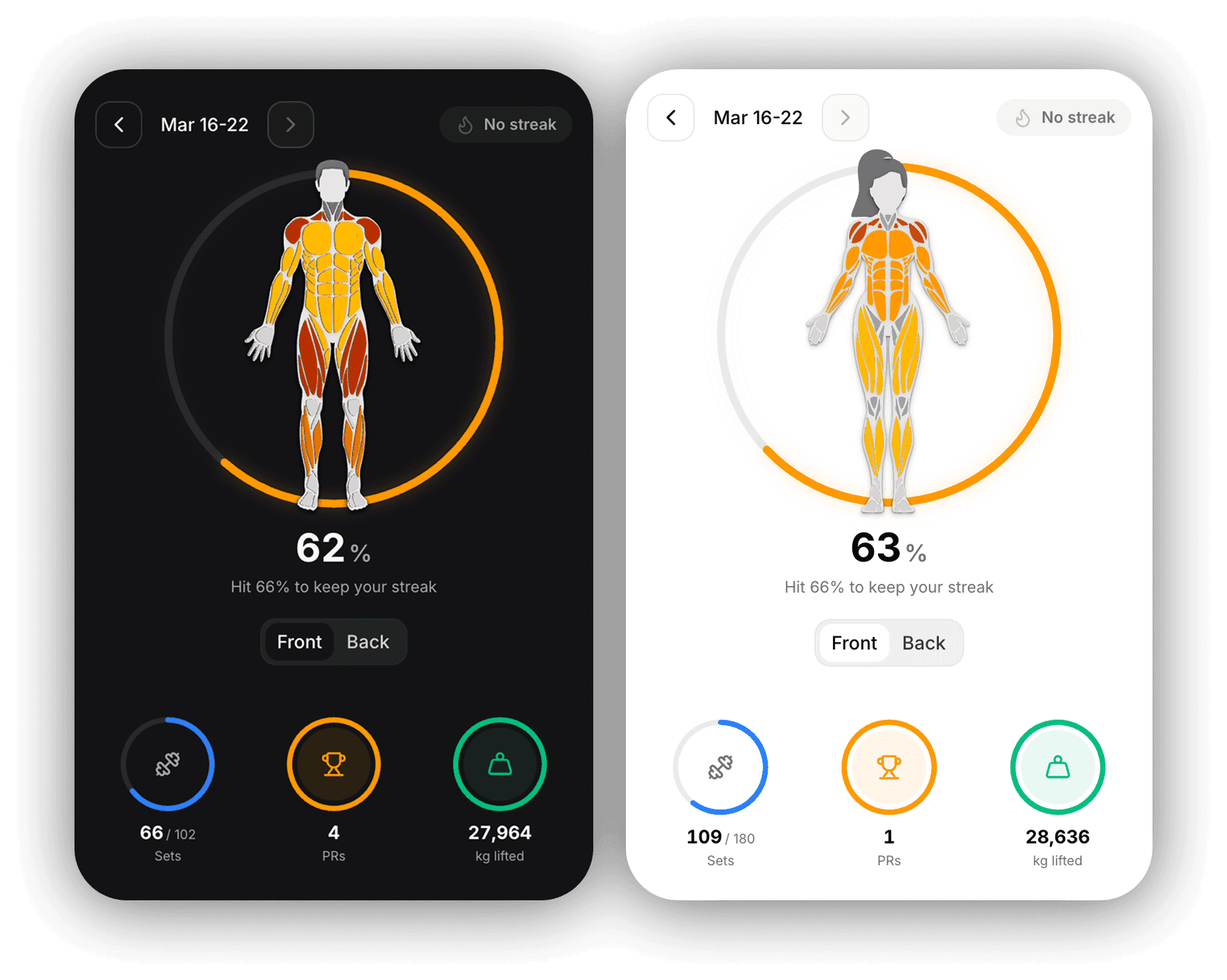
Hypro has structured training plans ready to start, with session logging and weekly volume tracking per muscle group so you can see whether you are hitting the minimum sets needed to protect your lean mass.
4-Day Full-Body Kickstarter
Day 1 of 4 · Full Body · 19 sets
Leg Extension
2x15-20, 2x12-15 · 45s rest
Smith Machine Squats
1x12-15, 1x10-12, 1x6-8 · 45s rest
Chest Press Machine
2x12-15, 1x8-12 · 45s rest
Lat Pulldown
2x12-15, 1x8-10 · 45s rest
Romanian Deadlift
1x12-15, 1x10-12, 1x8-12 · 45s rest
Plank
3xhold · 45s rest
Day 1 of the 4-Day Full-Body Kickstarter. Start in your browser. Install Hypro when you want it on your Home Screen.
Set your numbers
The food side of fat loss requires knowing your maintenance calorie number, then eating below it. Hypro does not track food automatically, but these free calculators do the math for you, no login required.
- Calorie calculator: How many calories to eat per day to lose weight?
- TDEE calculator: What does your body actually burn in a day?
- Macro calculator: How to split your calories between protein, carbs, and fat?
- Body fat calculator: Where are you starting from?
Use these (or any food tracking app) to set your daily calorie and protein targets. Then use Hypro for the training side: plan your sessions, log sets and reps, and track weekly volume per muscle to make sure you are lifting enough to protect your muscle.
Want a personalized plan? Coaching
The app handles the training side automatically. But if you want someone to build both your training and your nutrition plan, and check in on your progress week to week, Hypro's coaching is the next step.
Hypro coaches are experienced trainers, many of them IFBB competitors, who build personalized programs and deliver them directly in the app. They can create a custom training plan and a meal plan that fits your schedule, food preferences, and calorie targets. Both are shared through the app. Meal plans stay accessible in your account even if your coaching arrangement changes later.
See coaching options on the pricing page.
Start a structured training plan, log your sessions, and track weekly volume per muscle so training does its job while your diet handles the deficit. Your first plan is free.
Try Hypro free
Maciej Glowacki
Founder and CEO of Hypro. Built the platform from the ground up with years of hands-on lifting experience.