Kettlebell Workout Plan: A 4-Day Routine for Strength and Muscle
One kettlebell, a patch of floor, and about 30 minutes can support a serious workout. This 4-day kettlebell workout plan combines presses, rows, squats, carries, and swings. It is built to be useful, not to pretend one small swing study proves everything people claim about kettlebells.
 Maciej Glowacki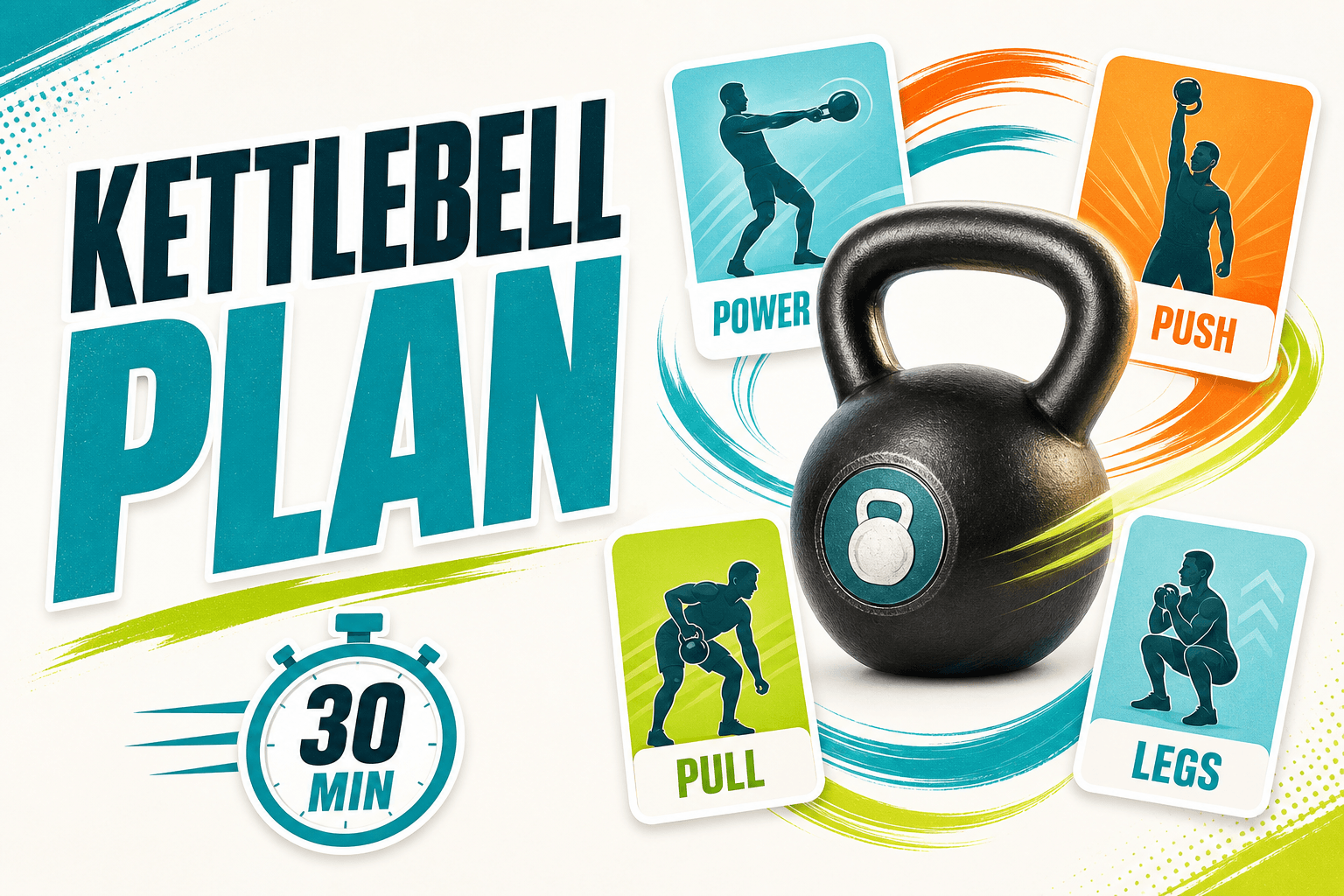
This plan covers the whole body with one piece of equipment. Squats and lunges train the legs. Presses work the chest and shoulders, rows work the back, and swings add power.
Use the kettlebell exercise library for form videos, step-by-step instructions, and coaching cues for the movements already available in Hypro.
A 2012 study by Lake and Lauder gives us a useful but limited clue. It put 21 healthy young men through six weeks of either kettlebell swings or jump squats, twice per week. Both groups improved their half-squat strength and vertical jump. That tells us swings can help strength and power in this group. It does not prove kettlebells are better for muscle growth or fitness. The four-day plan below adds the presses, rows, and squats that the study did not test.
Key takeaways:
- A small 2012 trial found that twice-weekly swings improved half-squat strength and vertical jump in healthy young men. Treat that as promising, population-specific evidence.
- The plan uses 4 sessions of roughly 30 minutes in a push, pull, and lower-body structure.
- For muscle growth, presses, rows, squats, and hinges still need progressive, challenging sets. Swings alone do not cover the whole body.
- Start with a bell you can control for the target exercise while keeping the planned RIR. Presses usually need less load than swings or goblet squats.
- Kettlebells trade fine load increments for compact equipment and natural ballistic exercises. Choose them because those constraints suit you.
The complete 4-day kettlebell workout plan
Four sessions per week, roughly 30 minutes each, scheduled as 2-on/1-off/2-on (for example Monday, Tuesday, Thursday, Friday). The emphasis changes by day, while presses, pulls, squats, and hinges appear repeatedly across the week:
| Day | Emphasis | Core exercises |
|---|---|---|
| Monday | Swings and press | Kettlebell swings, overhead press, goblet squats |
| Tuesday | Pull and carry | Floor press, supported row, reverse lunge, suitcase carry |
| Wednesday | Rest | |
| Thursday | Legs and hinge | Goblet squat, single-leg RDL, half-kneeling press, row |
| Friday | Power and full body | Swing, push press, reverse lunge, high pull |
| Weekend | Rest |
Monday: swings and press
| Exercise | Sets x Reps |
|---|---|
| Kettlebell swings | 4 x 12-15 |
| Single-arm overhead press | 3 x 6-10 per arm |
| Goblet squats | 3 x 8-15 |
| Single-arm row | 3 x 8-12 per arm |
Tuesday: pull and carry
| Exercise | Sets x Reps |
|---|---|
| Single-arm floor press | 3 x 8-12 per arm |
| Supported single-arm row | 3 x 8-12 per arm |
| Reverse lunge | 3 x 8-12 per leg |
| Suitcase carry | 3 x 30-45 seconds per side |
Thursday: legs and hinge
| Exercise | Sets x Reps |
|---|---|
| Goblet squat | 4 x 8-15 |
| Single-leg Romanian deadlift | 3 x 8-12 per leg |
| Half-kneeling press | 3 x 8-12 per arm |
| Single-arm row | 3 x 10-15 per arm |
Friday: power and full body
| Exercise | Sets x Reps |
|---|---|
| Kettlebell swing | 4 x 10-15 |
| Push press | 3 x 6-10 per arm |
| Front-rack reverse lunge | 3 x 8-12 per leg |
| High pull | 3 x 8-12 per arm |
Rest long enough to keep the planned reps and technique, often 60-120 seconds for the strength exercises. Pair non-competing movements when that does not reduce performance. Keep strength sets around the planned RIR, but stop swings and high pulls before speed or bell path breaks down. Warm up with controlled hinges, light goblet squats, and halos before adding speed.
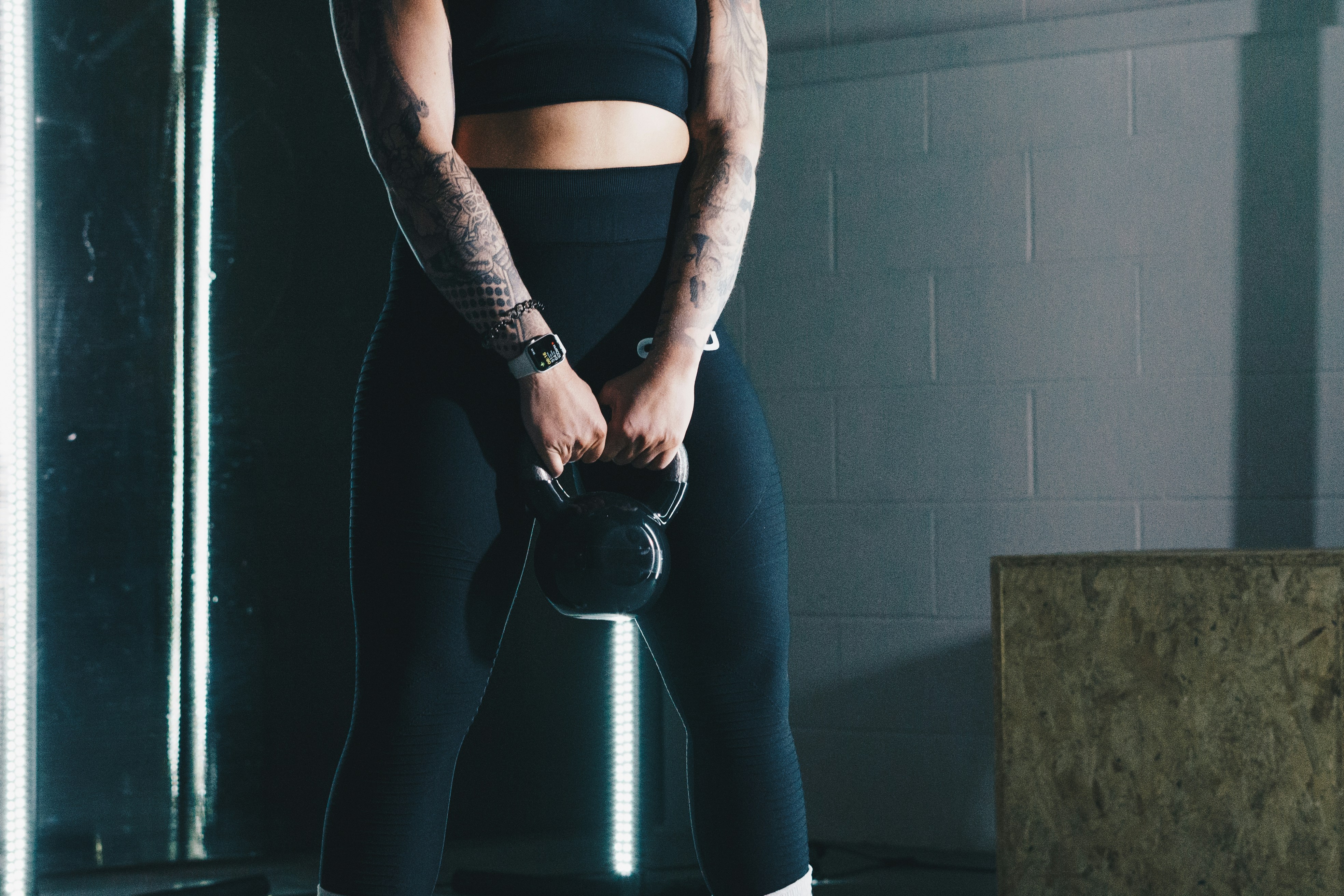
Can you build muscle with kettlebells?
Yes, provided the exercises challenge the target muscles and can progress. A 2023 network meta-analysis by Currier et al. found hypertrophy across many combinations of resistance-training load, sets, and frequency. It did not directly compare kettlebells with every other implement, so the practical case matters: kettlebells can load presses, rows, squats, hinges, and single-leg work through useful ranges.
- Effort. Use RIR to keep strength sets challenging while technique stays controlled. Ballistic work such as swings should stop when speed or form degrades rather than chase failure.
- Weekly volume. Count the listed strength sets by their main target muscles, and count indirect work conservatively. Do not treat every swing as a full hypertrophy set for every posterior-chain muscle. Start with the table, track performance, and adjust one area at a time.
The honest limitation: a single kettlebell may eventually stop providing enough load for lower-body work. Single-side variants, pauses, and double-kettlebell exercises extend the runway. When those no longer challenge the target muscles in a useful rep range, a heavier dumbbell, another kettlebell, or a barbell is the next step.
What size kettlebell should you start with?
Kettlebells often jump in 4 kg increments, so starting size matters. There is no reliable men's bell and women's bell. Test the movement, not the label:
| Exercise class | Starting test |
|---|---|
| Swings, goblet squats | Crisp reps through the planned range without losing the hinge or bracing |
| Presses, rows | Controlled reps with the target RIR and no twisting to finish |
| Snatches, cleans | Technique stays smooth before fatigue changes the bell path |
The Lake and Lauder study used 12 kg for subjects under 70 kg body weight and 16 kg above. That was the trial's loading rule, not a universal buying guide. When the top of a rep range leaves more RIR than planned, move up a size or add reps before taking the 4 kg jump.
Progression works like any program: add reps or load over time and track it. The progressive overload calculator tells you when to move up on each lift.
Kettlebells vs dumbbells vs barbell: honest comparison
| Kettlebell | Dumbbells | Barbell | |
|---|---|---|---|
| Strength and power | Natural fit for swings, cleans, and snatches | Easy unilateral loading | Easiest to load very heavy |
| Hypertrophy programming | Productive until load jumps or available weight limits progression | Fine increments and many angles | Fine increments on bilateral lifts |
| Conditioning options | Swings, carries, and complexes | Carries and complexes | Usually programmed separately |
| Space and cost | One bell, minimal | Adjustable pair, moderate | Rack and plates, most |
| Load precision | 4 kg jumps | 2 kg jumps | 0.5-2.5 kg jumps |
If maximum muscle is your only goal and you have gym access, barbells, dumbbells, and machines make precise loading easier. If compact equipment and ballistic work matter to you, kettlebells are a strong fit for the constraint. The useful question is not which tool wins the internet. It is which one lets you load the movements and keep progressing.
Browse Hypro's kettlebell-only plan, try one demo day for free, or test the complete plan during the 7-day Premium trial.
Browse training plans
Maciej Glowacki
Founder and CEO of Hypro. Built the platform from the ground up with years of hands-on lifting experience.